AGU
AGU


 Russian
 English
ASU News
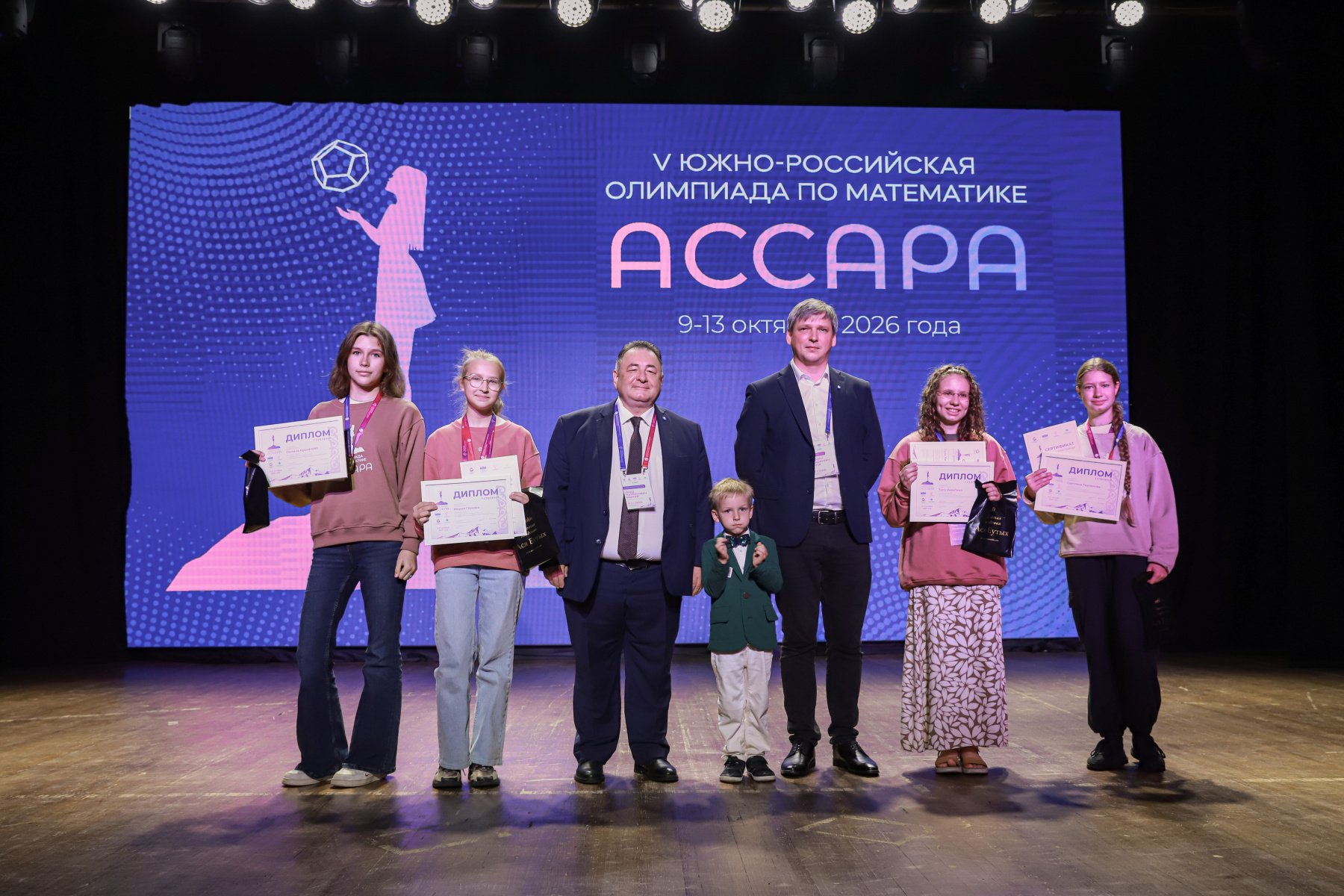 The 5th South Russian Mathematical Olympiad “Assara” has concluded at Adyghe State University. The Olympiad aims to promote mathematical Olympiads and foster girls’ interest in mathematics, identify and support talented schoolgirls, and provide opportunities for their intellectual development and future career choices.
This year, 52 schoolgirls from 21 Russian regions and two other countries—Abkhazia and Uzbekistan—took part. Participants included promising competitors from last year’s Olympiad, students admitted to the November 2026 mathematics programme at the Sirius Educational Center, winners and runners-up of the 2025–2026 final rounds of the All-Russian School Olympiad in Mathematics (Grade 9) and the Euler Olympiad (Grades 7–8), and schoolgirls admitted on the council’s recommendation in recognition of their achievements.
The winners were determined in the junior and senior leagues.
In the Junior League (8th grade), three participants won gold medals and first-place diplomas: Svetlana Terlikova and Polina Krokhaleva from the Rostov Region, as well as Maria Glukhova from the Samara Region, who demonstrated excellent results despite being in the 7th grade, unlike her competitors. Silver medals and second-place diplomas were awarded to Maria Ryazanova from the Kurgan Region and Olga Vovk from the Krasnodar Region. Bronze medals and third-place diplomas were awarded to Miroslava Shushueva (Krasnodar Region), Veronika Kokina (Kurgan Region), Sibel Zakhidova (Republic of Uzbekistan), Aelita Armanova (Republic of Kalmykia), Evangelina Timoshenko (Krasnodar Region), Elizaveta Trofimova (Kurgan Region), and Varvara Martynova (Volgograd Region).
In the senior league (grades 9–10), Tala Nikitina from the Moscow Region was recognized as the strongest, winning a gold medal and a first-place diploma. Silver medals and second-place diplomas were awarded to Anfisa Samofalova and Maria Vorontsova from the Tyumen Region, Ulyana Brantova (Moscow Region), Daria Mikhailova (Moscow Region), and Yara Mamiy (Republic of Adygea). Bronze medalists with third-place diplomas included Varvara Sukhova (Tyumen Region), Kamilla Salagaeva (Republic of North Ossetia-Alania), Victoria Menshchikova (Kurgan Region), Saniyat Mirzaalieva (Republic of Adygea), Anastasia Evdokimova (Volgograd Region), Irina Temiraeva (Republic of North Ossetia-Alania), and Sofia Gabrielyan (Kurgan Region).
Let's remember that the Assara Olympiad has no analogues in Russia. It's not just, or even primarily, a competition, but a space to motivate and support girls' desire to pursue science.
“We designed the program to broaden participants’ horizons, help them better understand themselves, and show them that mathematics can open doors to a career and greater social opportunities. Participants can connect with women who have built successful careers in mathematics, draw inspiration from new projects, and see how it is possible to pursue professional ambitions while building a fulfilling personal life and family. We have seen that this format has wide appeal. Over the past five years, the South Russian Mathematical Olympiad ‘Assara’ has grown beyond southern Russia. It now brings together talented schoolgirls who are passionate about mathematics—not only from across the country, but also from abroad,” said Daud Mamiy, rector of ASU.
The Olympiad consisted of two in-person rounds. In each round, participants were asked to solve four problems. The competition lasted 3.5 hours for the Junior League and 4 hours for the Senior League.
According to Kirill Sukhov, the Olympiad jury chairman, head coach of the Russian national team at the International Mathematical Olympiad, and head of the Laboratory of Technologies for Teaching Mathematical Ideas at ASU , this year's problems were more challenging than those at previous Olympiads. However, the authors did not set out to make the problems more difficult. They tried to focus on the skill level of the selected participants to motivate them to further develop.
"The number of mathematics Olympiad participants who solve truly challenging and interesting problems is growing, thanks in part to this Olympiad. Most of these girls wouldn't have participated in events of this level without Assara. They simply wouldn't have made it to the Caucasus Mathematical Olympiad or the All-Russian School Mathematics Olympiad. But here, they solved challenging problems, saw the beauty of mathematics, and were inspired to continue working, try to qualify for future competitions, and consider their potential in this field," said Kirill Sukhov.
The solutions were evaluated by leading figures in the Olympiad community, including members of the jury for the All-Russian School Olympiad in Mathematics, Olympiad medalists, university professors, and directors of specialized educational programs.
The jury also includes several accomplished women in mathematics: Alisa Volkova, a student at the Faculty of Mathematics and Computer Science at St. Petersburg State University and a teacher of supplementary education at Presidential Physics and Mathematics Lyceum No. 239 in St. Petersburg. She won gold medals at the 2023 International Mathematical Olympiad and Romanian Mathematical Olympiad, and was a two-time winner of the European Girls’ Mathematical Olympiad (2022 and 2023).
Other jury members include Irina Klimanova, a teacher in the Department of Discrete Mathematics and the Department of Algorithms and Programming Technologies at the Moscow Institute of Physics and Technology; Karine Kuyumzhiyan, an associate professor at the Faculty of Mathematics at the National Research University Higher School of Economics and a winner of the final round of the All-Russian School Olympiad in Mathematics; and Alina Sukhova, a teacher of supplementary education at Presidential Physics and Mathematics Lyceum No. 239 and a member of the jury for the All-Russian School Olympiad in Mathematics.
Alongside the competition and the jury’s review of the problems, the Olympiad offered a rich cultural program designed to broaden students’ horizons. Participants toured Maykop and the Golden Pantry Museum, dedicated to Asya Eutykh, Russia’s only female gunsmith and jeweler. The program also included a visit to the open-air Mathematical Park; a sand-painting workshop with Mezaga Tesheva; a Caucasian yoga class with Zaur Zhane; a meeting with designer Tatyana Frolova; a lecture by Nafiset Kidakoeva, “Girls’ History: Traditions and Modernity”; and a concert by the Krasnodar cover band Otzhigova Slovar, featuring lead singer Kristina Horvat.
The Olympiad is organized by Adyghe State University (ASU), the Republican School of Natural Sciences and Mathematics (REMSH), and the Ministry of Education and Science of the Republic of Adygea, with the support of Sberbank.
More photos from the closing ceremony here - https://vk.ru/kavmatagu?z=album-163532021_312113330