AGU
AGU


 Russian
 English
ASU News
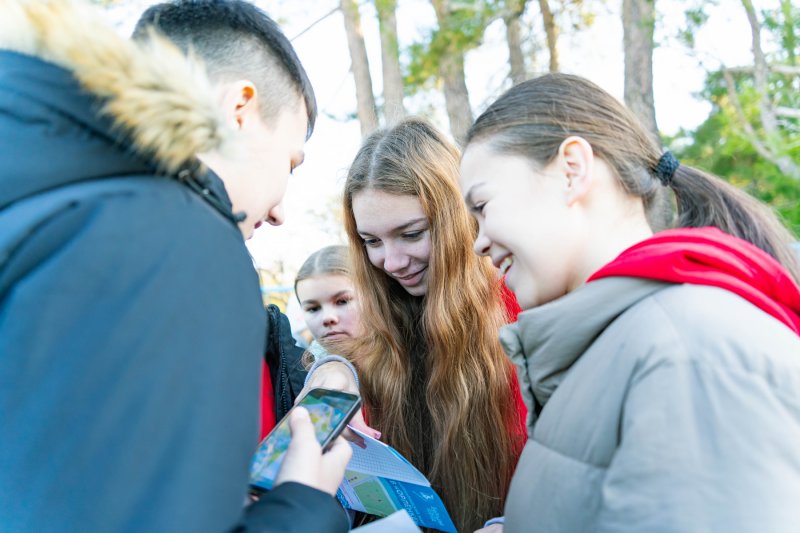
The events were developed in celebration of Mathematician's Day, initiated by Daud Mamiy, Rector of Adyghe State University, and organized jointly with the All-Russian Children's Center "Orlyonok." The "Mathematical Run at Orlyonok" was conceptualized by Danel Musatov, a senior researcher at the Caucasian Mathematical Center of ASU and the long-time creator of a similar annual event in Maykop, "Integral Around the City."
Nearly 200 members of the Movement of the First Shift, divided into 42 teams, explored the VDC grounds in search of 20 points marked on the map and three secret locations. The most resourceful teams were able to find these points by following clues. At each station, children earned points by solving mathematical problems developed by Danel Musatov, utilizing tables and referencing geographic, topographic, architectural, and cultural sites within the camp. Some tasks aligned with the school curriculum, while others reached Olympiad-level difficulty. The teams with the highest scores after 2.5 hours were declared winners. (Photo: Orlyonok Children's Center)
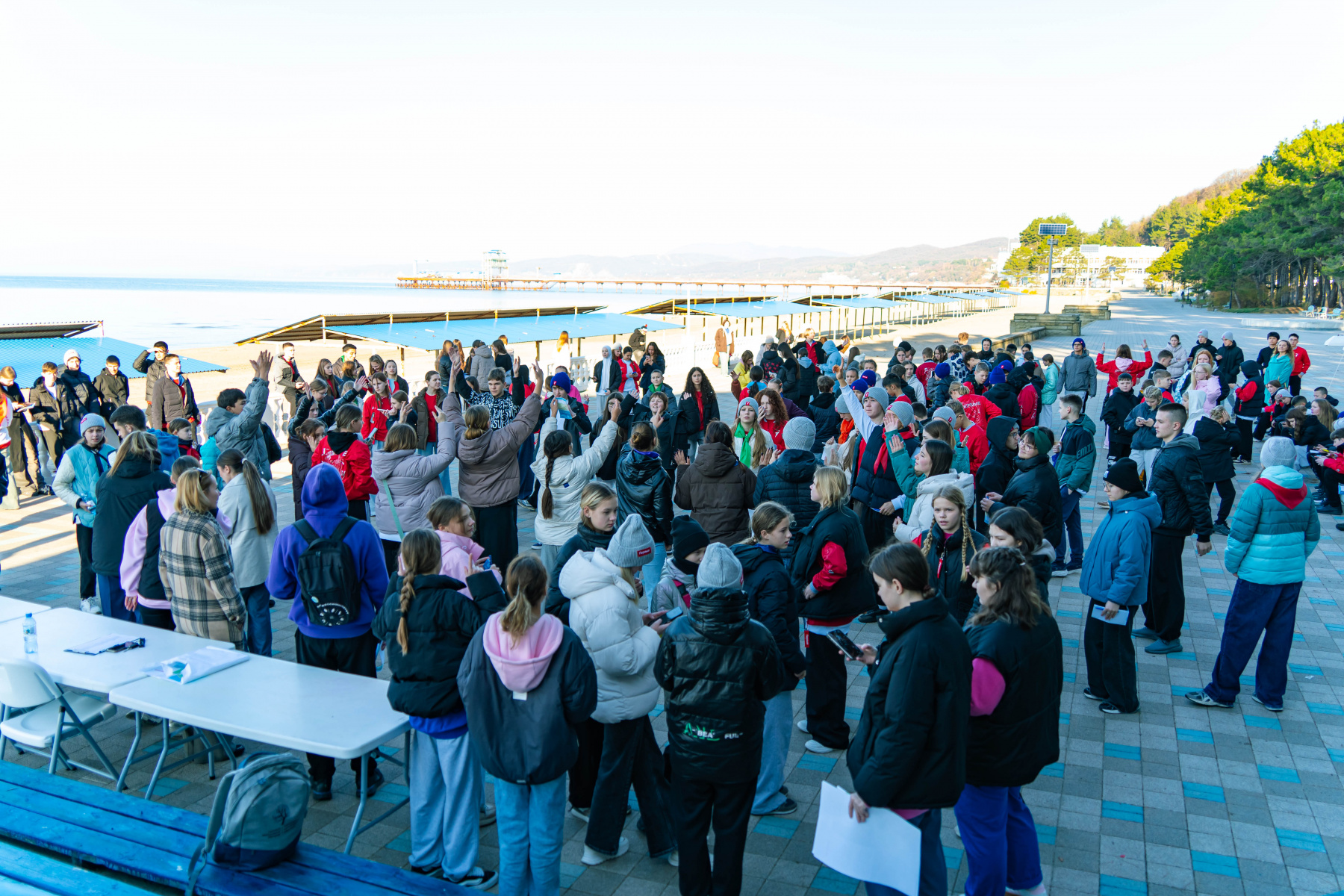
Фото: ВДЦ «Орленок»
In collaboration with the Mobius Games project, the Tetris math game was organized by Konstantin Bondarenko, founder of the All-Russian Mathematical Battles Tournament of the same name, a permanent jury member, and a member of the organizing committee for the annual Southern Mathematical Tournament organized by ASU's KMC. Teams were given a special grid resembling the classic computer game Tetris and earned puzzle pieces by solving sets of four problems. Correct solutions allowed teams to select and place pieces on the grid without overlaps, aiming to complete rows for points—10 points per fully completed row, and points equivalent to filled cells for partially completed rows.
The game was held in two age categories: the first included 50 students from grades 5-7, forming 12 mixed teams; the second comprised over 60 students from grades 7-10, playing in 18 teams. While the problems matched their grade levels' academic knowledge, the conditions were designed to be more challenging and engaging than standard classroom settings. Konstantin Bondarenko emphasized the event's dynamic nature and the enthusiastic problem-solving displayed by participants. "The children's reactions showed that the event was a success. Experience has proven that holding diverse activities for children is beneficial, and math competitions fit perfectly into the program of non-math-focused sessions," he shared.
As a reminder, the Regional Scientific and Educational Mathematical Center of Adyghe State University—the "Caucasian Mathematical Center" (CMC ASU)—is a subdivision of ASU. The center aims to enhance mathematical research and improve the quality of mathematics education across Adygea and the broader southern Russia region. Established in 2017 following a competitive selection process by the Russian Ministry of Education and Science, CMC activities are conducted by ASU’s research team in partnership with the Moscow Institute of Physics and Technology under the academic supervision of Professor Andrey Raigorodsky.